The Reading Stack
What has to change before the tools matter, and why curation is the harder practice
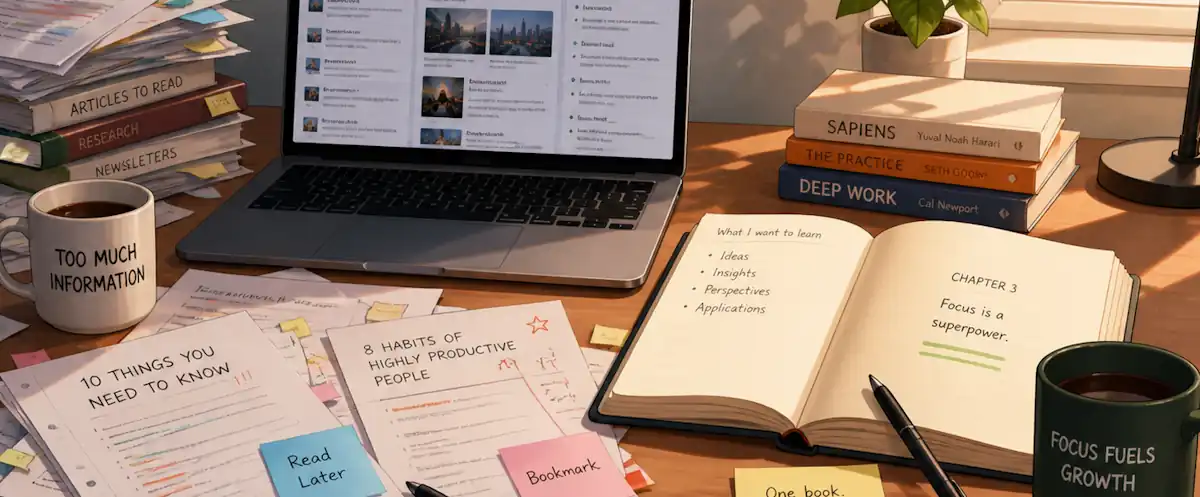
My inbox never fully empties (Inbox Zero is a myth). That’s been true of email for decades, and it’s now true of everything else — newsletters, Slack channels, LinkedIn, and good old RSS feeds. Every solution to information overload eventually became another source of it. The volume kept growing, but my reading time didn’t.
For a while I handled it the way most people do by defaulting to faster skimming and lighter engagement, relying more on something interesting surfacing through a conversation or a forwarded link. That’s a fragile system.
What I’ve been building (slowly, and still adjusting) is a pipeline that runs in the opposite direction from the old model.
The Inversion
The traditional model was reactive, where you subscribed to sources and sorted whatever arrived. The better you got at filtering, the more sources you added because filtering felt sustainable. For most of us, it wasn’t.
There’s usually a collapse point where the inbox gets too full and the feeds become background noise. You start relying on serendipity, where something interesting surfaces through a conversation or a forwarded article and that becomes how you stay current. It works until it doesn’t, and you often don’t notice it stopped working until the gaps become visible beyond “trending topics” lists.
The inversion flips the sequence. Instead of subscribing broadly and filtering down, you build a short list of sources you actually trust and stop adding to it. These are publications that earn their place and writers you follow for depth, not reach. Curation happens upstream before content arrives, so what shows up is already filtered by intent.
From there, tools take over the aggregation and synthesis work that used to require your direct attention, and your job becomes deciding where to go deeper rather than managing the volume.
How the Flow Changed
Before
Now
What the right side of that diagram looks like in practice: a topic surfaces that I want to understand properly. Before, I’d read whatever arrived and move on, rarely hunting down related perspectives or counterarguments unless it piqued my interest. Now the automation tools (based on the sources, prompts, and goals I have for my learning journeys) synthesize what my curated sources have collectively said, research and surface the counterarguments, and show where there’s genuine disagreement versus emerging consensus. That’s the research I would have done manually but rarely did because the cognitive load of doing it for everything is too high. The tools absorb that load and, occasionally, the synthesis surfaces a source I hadn’t encountered before, so the trusted list can grow organically without requiring me to seek out additions manually.
The specific tools that make this work are covered in a post from last December that still holds up, but what I didn’t write about then was what has to happen before you pick up any of them.
Change Is Hard
The tools are the easier part of this.
Building a new practice requires upstream work that no tool can do for you. Knowing what you actually want to stay current on, rather than what you’ve accumulated subscriptions around, is harder to figure out than it sounds. Most source lists are more habit than intention, as I’ve been trimming mine for months and still, just recently, found a newsletter for an educational ecosystem I used to maintain 20+ years ago on Novell Netware. I’m sure those can go.
The habit side is equally real, because trying a new tool once when you’re stuck doesn’t change how you process information. The change comes from using it consistently, building the reflex to route material the right way before you attempt to read it all at once. That takes repetition and some tolerance for the workflow feeling slower before it clicks.
When the practice is working, I spend less time hunting for sources and make better decisions about where to invest reading time, because the summary-first approach surfaces what’s actually worth the depth.
I’m still calibrating, as the sources I trust have shifted and what I reach for first looks different from six months ago. That’s probably not going to stop, which is fine. The goal isn’t a finished system but a practice that keeps improving.
The interesting question isn’t which tools to use but whether your information consumption practice is intentional or just accumulated.
I think most of ours are accumulated. A newsletter that made sense for a different role. A feed you never unsubscribed from. The volume compounds as the signal-to-noise ratio quietly degrades, and the coping strategy tends to be reading faster or stopping entirely.
The inversion I’m working toward is treating curation as the primary practice and consumption as the output of it. Still getting there and probably always will be.